How to Choose the Right Setup for Your Full-Body Red Light Therapy Panel
Buying a full-body red light therapy panel is a significant investment in your long-term health, cellular energy, and systemic recovery. However, once your premium device arrives, you face an immediate, practical challenge: How should you actually mount, position, and support a heavy, large-scale light panel (often weighing anywhere from 25+ kg) for your daily routine?
Depending on your room layout, budget, and therapy habits, there are several ways to set up a large-scale panel. To help you find the setup that best fits your lifestyle, we have broken down the four most common options on the market, outlining their typical use cases, real-world pros and cons, and everyday adaptability.
1. Permanent Wall Mounts & Hanging Kits
This is the standard entry-level setup method. Almost all premium brands include a standard wall-mounting template or over-the-door hanging kits right inside the box with your full-body panel.
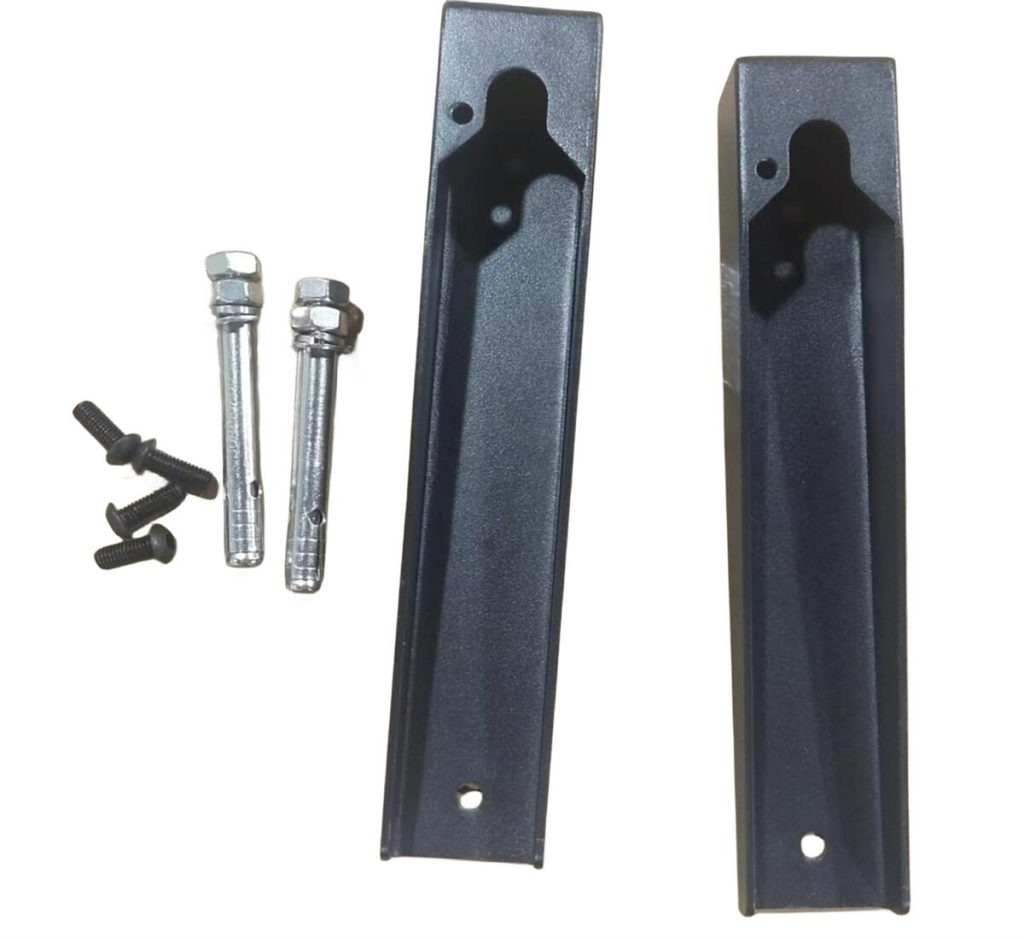
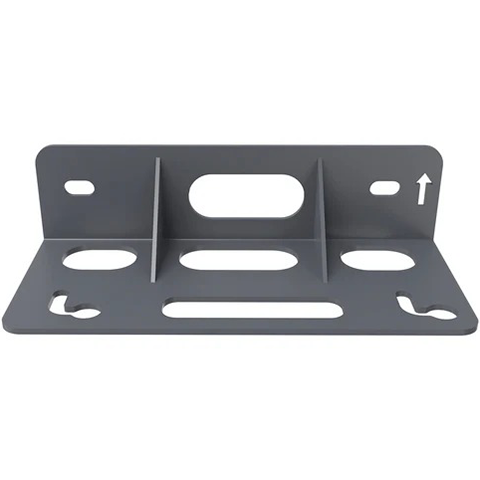
Best For: Users with highly limited floor space who only plan to stand upright during their therapy sessions, or fitness enthusiasts looking to build a massive, permanent “Haaland-style” Red Light Wall by bolting multiple panels together onto a dedicated gym or recovery wall.
The Pros:
- Cost-Efficient: It comes included as a standard option with your panel investment.
- Space Saving: Takes up absolutely no active floor space in your room.
- Absolute Safety: Since it is securely anchored into wall studs, there is zero risk of a heavy panel tipping over.
The Cons:
- Zero Fluid Versatility: The panel is locked flush against a single vertical surface. You cannot tilt the light source to face a comfortable lounge chair or your bed.
- The Adjustment Friction: If multiple family members share the device, changing the height slots requires manually unhooking and lifting a heavy, oversized glass panel out of its slots. It can be physically awkward and presents a drop risk.
- Restricted Postures: Because the setup cannot move or tilt, you cannot comfortably engage in floor-level yoga mat routines or horizontal therapy while lying down flat.
2. Heavy-Duty Mobile Stands
This category takes the panel off the wall, mounting it onto an independent, wheeled steel chassis that allows users to relocate their setup between rooms. Depending on the lifting mechanism, these mobile frames are divided into two distinct configurations:
A. Manual Pin-Lock Stands
These traditional frames support heavy panels utilizing basic metal safety locking pins and manual twisting knobs.
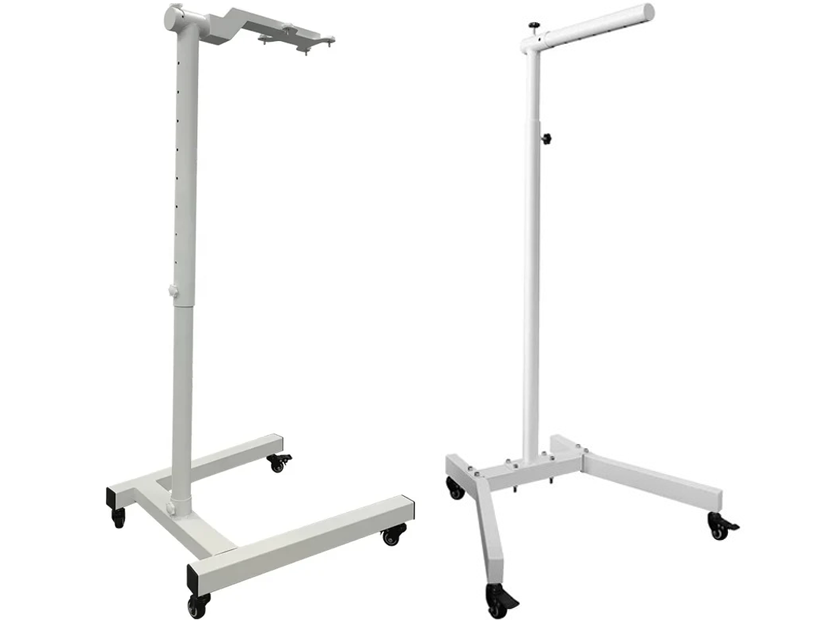
- Best For: Users on a budget who want mobility but intend to keep the panel at one permanent height setting.
- The Pros: Budget-friendly and offers an industrial metal build that handles large-scale weights reliably.
- The Cons: Adjusting the vertical height requires manually lifting and holding the weight of the panel with one hand while inserting pins with the other, making regular daily adjustments physically tedious.
B. Universal Hand-Crank Rotational Stands
This advanced mechanical configuration integrates a gear-driven winch system inside the central column combined with a 90-to-180-degree freely rotational headpiece. It allows users to smoothly raise or lower the panel by turning a manual crank handle and seamlessly tilt the orientation to any custom angle—whether standing vertically, relaxing at a 45-degree recline on a couch, or lying completely flat horizontally over a bed. Notably, innovative designs in this category (such as the BestQool and Bontanny stands) feature adjustable sliding clamp rails that eliminate the need for brand-specific mounting holes, allowing the frame to securely grip a wide variety of third-party panel sizes from different brands.
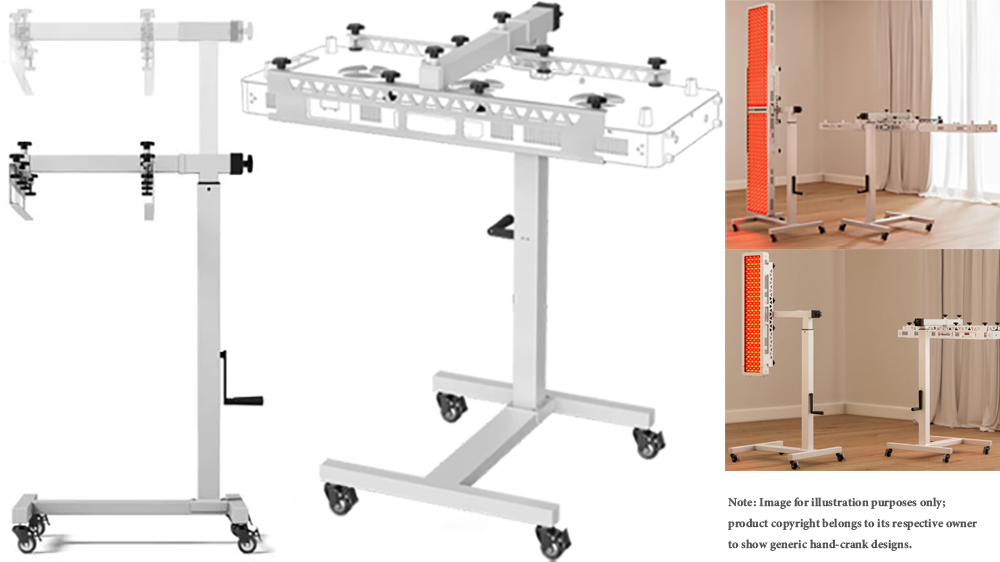
No Digital Automation: It lacks electronic control chips, meaning it cannot save customized height profiles or support smart memory presets for different family members.
Best For: Users who want complete freedom to unlock any therapy angle (standing, sitting reclined, or laying flat) along with wide brand compatibility, without being restricted by proximity to a power outlet.
The Pros:
- Infinite Angle Flexibility: The rotational head allows continuous, non-binary angle adjustments to perfectly parallel your posture in tilted armchairs or sofas.
- High Third-Party Adaptation: Universal sliding clamp systems remove the need for brand-specific screw holes, fitting most standard panels on the market.
- Cordless Placement Freedom: Operates entirely through mechanical leverage without electricity, allowing it to be placed anywhere in the home.
The Cons:
- Requires Manual Interaction: Unlike automated systems, users must still stand up, physically turn the crank handle, and manually loosen/tighten the heavy rotational joint knobs whenever changing heights or adjusting angles.
C. Detachable Dual-Orientation Pin-Lock Stands
This hybrid configuration adapts a television-style mounting bracket onto a dual-column wheeled chassis. It provides the ability to position the panel in either a strictly vertical or strictly horizontal plane, but completely lacks any dynamic internal rotational joints or gear winches.
The Cons: High operational friction. Because transitioning between postures or adjusting heights requires manual lifting, tools, and partial reassembly, most users find it too physically tedious to change layouts daily, effectively locking themselves into one single posture.
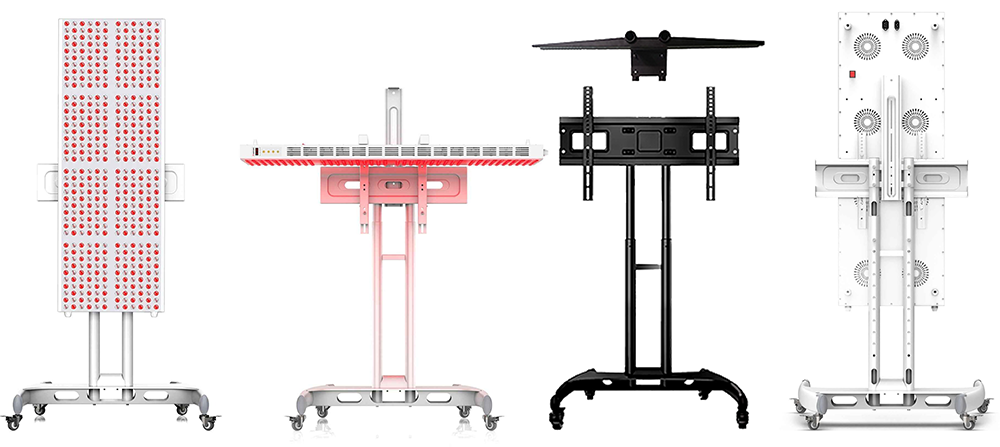
The Mechanics: To adjust the height, users must physically lift the heavy panel and columns with one hand while inserting physical locking pins with the other. To swap between vertical and horizontal setups, users cannot simply tilt the device; they must manually detach the heavy panel, unscrew or reconfigure the metal mounting hooks at the central connection joint, and then physically remount the panel in the alternative orientation.
Best For: Users who want the flexibility of both standing and laying therapy on a stricter budget, and who do not mind the heavy physical labor required during adjustments.
The Pros: Considerably more affordable than gear-driven hand-crank or motorized stands while still offering a highly stable, heavy-duty steel base.
3. Fixed-Angle Canopy Stands
This automated electric upgrade introduces a motorized central lifting column. It handles all the heavy vertical movement at the push of a button, but electronically restricts the panel’s rotation to just two fixed planes: exactly 0 degrees (vertical) or exactly 90 degrees (horizontal).
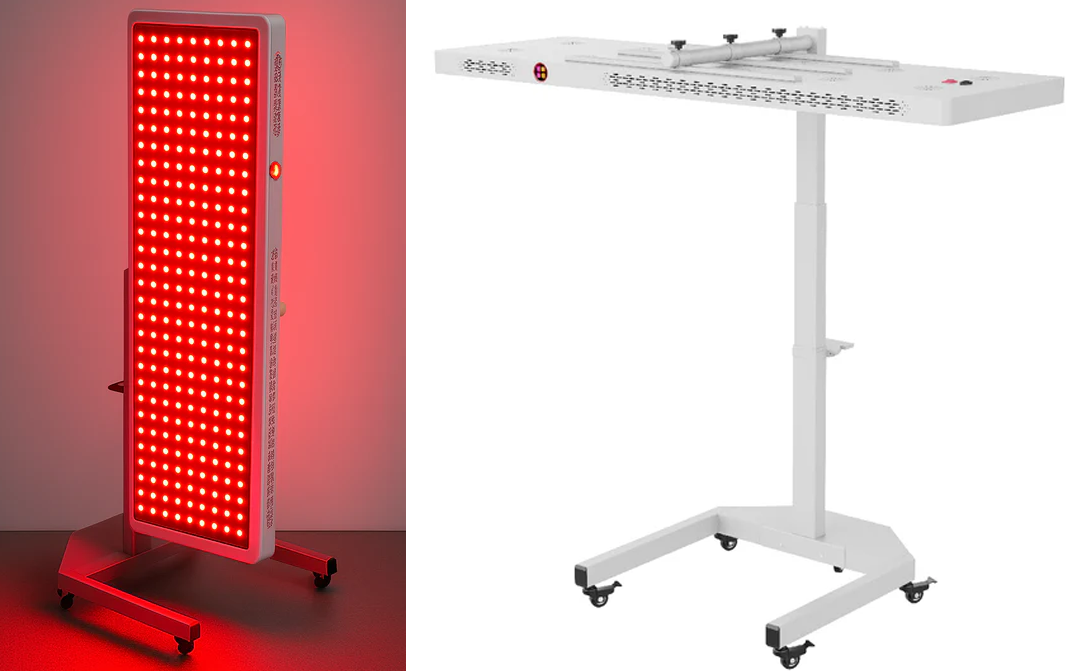
- Best For: Users who specifically prefer to receive their red light therapy strictly lying flat on a bed or a dedicated massage table, as the horizontal canopy mode safely suspends the panel overhead.
- The Pros:
- Effortless Lift: Motorized height travel eliminates physical lifting or cranking strain, providing a highly stable, rigid central column.
- Over-the-Bed Layout: Safely and reliably supports a true horizontal canopy layout directly over a bed frame or massage table.
- The Cons:
- Rigid Angle Bottleneck: The bracket mechanism locks strictly at 0 degrees or 90 degrees. It offers no fluid or custom mid-angle tilt.
- User Adaptation: If you want to sit back at a relaxed 45-degree angle in a reclined sofa, this stand cannot tilt to parallel your posture. You must adjust your body to fit the machine’s fixed paths.
4. Adaptive Smart Motorized Stands
This represents the premium, fully automated tier of red light infrastructure. While standard wall-mount kits work well for basic standing routines, an adaptive motorized stand is engineered as a luxury lifestyle upgrade designed to eliminate daily positioning friction. It seamlessly combines high-torque automated vertical travel with continuous, fluid angle articulation and intelligent digital memory tracking.
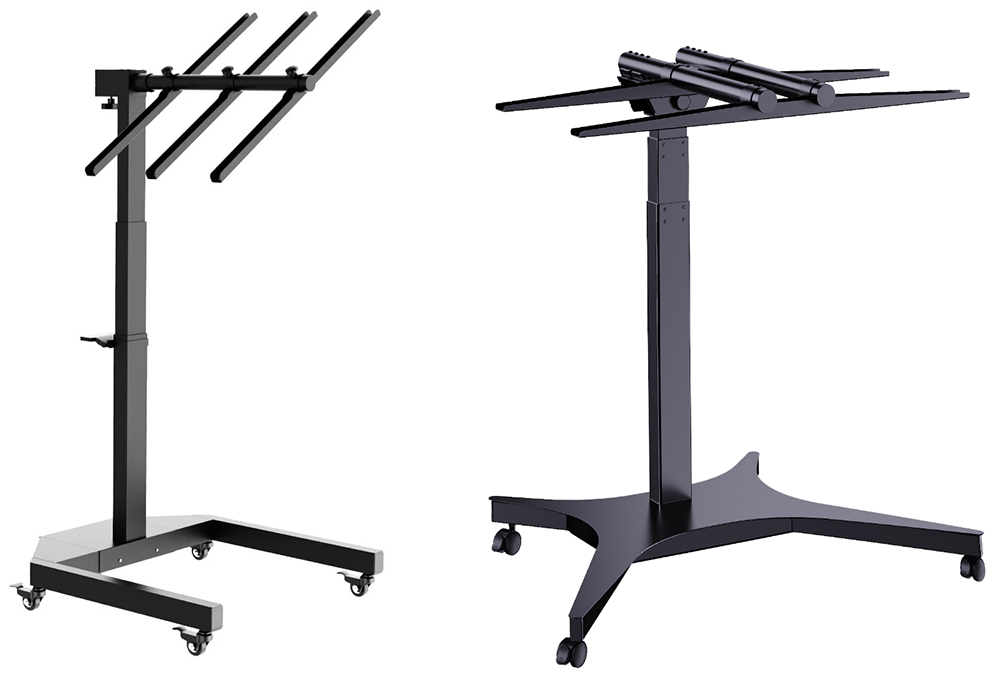
- Best For: Premium home wellness rooms, multi-user households, and professional clinics looking for maximum comfort, total hands-free convenience, and the absolute freedom to seamlessly transition between standing, sitting reclined, or lying flat.
- The Pros:
- 100% Automated Freedom: The panel shifts down to the exact millimeter and degree with a simple tap on the integrated control panel or a companion wireless remote.
- Universal Compatibility: Premium versions are engineered with a universal heavy-duty bracket system. Even if a user already owns a full-body panel from another major brand, these stands adapt seamlessly to give the current setup a true luxury upgrade.
- Elite Recovery Experience: Achieving elite-level cellular recovery no longer requires spending $50,000 on a commercial red light pod like Erling Haaland. By pairing a high-output panel with an adaptive motorized stand, users can mechanically create a horizontal “canopy layout” over a bed. This brings that same hands-free, full-body sleep and muscle optimization experience into a residential setting, discounted the cost.
- Intelligent Memory Presets: Much like a premium standing desk, these systems typically feature 3 programmable memory chips to save exact configurations (e.g., Preset 1 for Standing, Preset 2 for Seated, Preset 3 for Floor Mat). One touch configures the entire setup automatically.
- Low-Clearance Storage: The heavy-duty steel base is uniquely engineered with a low-profile chassis. This allows the wheels to slide directly underneath standard sofas or beds, tucking the heavy equipment away when not in use.
- Soft Start/Stop Transition: The advanced motors ramp velocity up and down gradually, ensuring a valuable full-body panel investment never encounters sudden structural jerks, shaking, or abrupt drops.
- The Cons:
- Requires a continuous proximity connection to an AC power outlet to operate the digital columns.
- A significantly higher upfront price investment compared to traditional non-electric manual frames.
- The solid steel stabilization base occupies a larger physical footprint to ensure a top-heavy setup remains completely tip-proof.
The Bottom Line
Standard setups are a reliable way to get started, and for many users who love a quick, standing-only post-workout recovery routine, it is entirely sufficient.
However, if you want your red light therapy to seamlessly blend into your relaxation hours—whether that means sitting back in your favorite armchair or lying down for a floor meditation session—handling a heavy panel manually quickly becomes a daily chore. By upgrading to an Adaptive Smart Motorized Stand, you remove all the physical friction, allowing your technology to perfectly adapt to your lifestyle—not the other way around.