
660nm Laser vs 660nm LED: The Key Differences Explained
660nm Is 660nm… So Are They Actually the Same? When you compare a 660nm therapeutic laser to a 660nm red LED panel, you might naturally ask: “They have the same wavelength and the same unit. Aren’t they basically the same thing?”
At first glance, the answer seems obvious. Both are labeled 660nm, so it may appear that the only difference is the device design or the way manufacturers describe their products.
However, the reality is more complicated.
Although both light sources operate around the same wavelength, they are created through completely different physical processes. Differences in light generation mechanisms, spectral characteristics, coherence, beam direction, and energy distribution determine how these two types of light behave.
In this article, we will break down the science behind 660nm laser and 660nm LED Light, helping you clearly understand what makes them different and why the same wavelength does not always mean the same type of light.
Single Photon Energy: Identical at 660nm, Gap Lies in Power Density
According to fundamental quantum physics, the microscopic energy of a single photon is uniquely determined by its wavelength[1].
This establishes an absolute baseline truth: a single photon emitted from a 660nm laser and a single photon emitted from a 660nm LED carry identical individual energy, roughly 1.88 eV (electronvolts)[1].
No matter whether a photon originates from laser stimulated emission or LED spontaneous emission, its molecular capacity to trigger mitochondrial Cytochrome c Oxidase (CCO)—the primary photoacceptor in photobiomodulation (PBM)—is completely equivalent[2, 3]. Multiple comparative cellular and clinical studies have confirmed that non-coherent LED light and coherent laser light elicit virtually identical bio-stimulation effects when wavelength and energy density are held equal[4, 5].
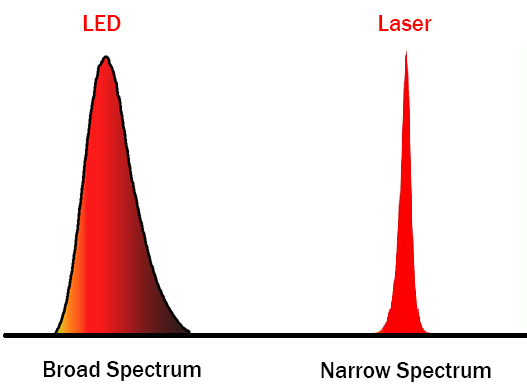
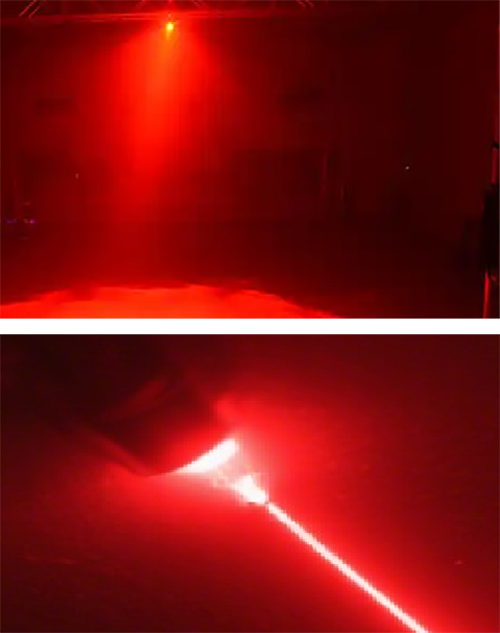
The defining physical divide exists not in individual photon strength, but in photon flux density and power density (Irradiance, mW/cm2)—how many photons strike a specific unit area of tissue per second, which dictates whether cells cross the required threshold for PBM activation[6].
- Therapeutic Lasers: Focus massive photon counts into a tiny, pinpoint spot, creating ultra-high local power density.
- Standard LED Panels: Scatter photons across a wide spatial area, spreading energy broadly across superficial skin layers.
Core Light-Generating Mechanism: Stimulated Emission vs. Spontaneous Emission
How photons are born determines their optical purity and spectral behavior.
> 660nm Laser: Light Amplification by Stimulated Emission of Radiation
Laser diodes rely on stimulated emission within a microscopic resonant optical cavity equipped with 660nm Laser: Light Amplification by Stimulated Emission of Radiation
Laser diodes rely on stimulated emission inside a microscopic resonant optical cavity equipped with highly reflective mirrors:
- Electrical energy creates population inversion, pushing electrons into high-energy excited states.
- A random initial photon passes excited electrons, inducing a domino effect that unleashes identical “clone photons.”
- These generated photons match the original photon’s frequency (wavelength), phase, travel direction, and polarization state.
- Photons bounce repeatedly between cavity mirrors to amplify the beam, naturally filtering out stray wavelengths outside 660nm.
This process yields ultra-monochromatic light with an extremely narrow spectral linewidth (Full Width at Half Maximum, FWHM < 5nm), creating a needle-thin spectral peak on analytical graphs.
> 660nm Red LED: Spontaneous Electroluminescence
LED chips generate light purely through spontaneous emission without an optical resonant cavity:
- Electric current crosses the semiconductor PN junction.
- Excited electrons drop back to lower energy states, releasing photons at random times and random angles.
- Lacking a mirror cavity to filter stray frequencies, standard LED emission naturally spreads across a wider wavelength band (typically a Full Width at Half Maximum of 20–30nm).
💡 Clarifying the Optoelectronic Industry Standards: Peak Tolerance vs. Spectral Bandwidth
In the LED panel industry, specifications often reference ” ±5nm” or “±10nm.” It is essential to distinguish between two frequently confused optoelectronic concepts:
Center Wavelength Tolerance (Peak Binning, e.g., ±5nm): Refers to the manufacturing precision of chip binning. A “660nm ± 5nm chip” guarantees that the highest emission peak of every diode across the panel falls strictly between 655nm and 665nm.
Spectral Bandwidth (FWHM, e.g., 20–30nm vs. ~10nm): Refers to the energy dispersion width of the emitted light around that peak. Standard LED arrays exhibit broad energy leakage spanning a 20–30nm range, whereas medical-grade, precision-filtered LED arrays compress this spectral width significantly closer to the target absorption peak.
Coherence and Directionality: The Optical Divide
> 660nm Laser: Coherent and Highly Collimated
- Coherence: Laser light exhibits both spatial and temporal coherence—wave crests and troughs align perfectly in phase. As photons penetrate tissue, spatial coherence creates micro-interference patterns known as “laser speckle,” which some research suggests enhances localized cellular stimulation.
- Directionality: Extremely narrow beam divergence allows laser light to travel parallel over long distances without spreading, delivering pinpoint deep energy without lateral scattering.
> 660nm Red LED: Non-Coherent and Custom Optical Beam Angles
- Non-Coherence: LED photons are released randomly with mismatched phases, making the light non-coherent. Energy transfers smoothly and continuously to cell layers without wave interference [4].
- Directionality: Bare LED chips naturally radiate light at a wide 120° angle. However, professional therapy panels utilize secondary optical lenses (commonly 30° to 60° for deep energy concentration, or up to 90° for broad coverage) over each chip to optimize photon flux, minimizing lateral dispersion and delivering customized, uniform coverage over targeted surface areas.
Biological Action Pathways and Tissue Penetration Logic
Both 660nm lasers and 660nm LEDs trigger identical intracellular PBM pathways[2, 4]:
Absorption by Mitochondrial CCO -> Nitric Oxide (NO) Release
However, their delivery logic and depth targeting follow distinct strategies:
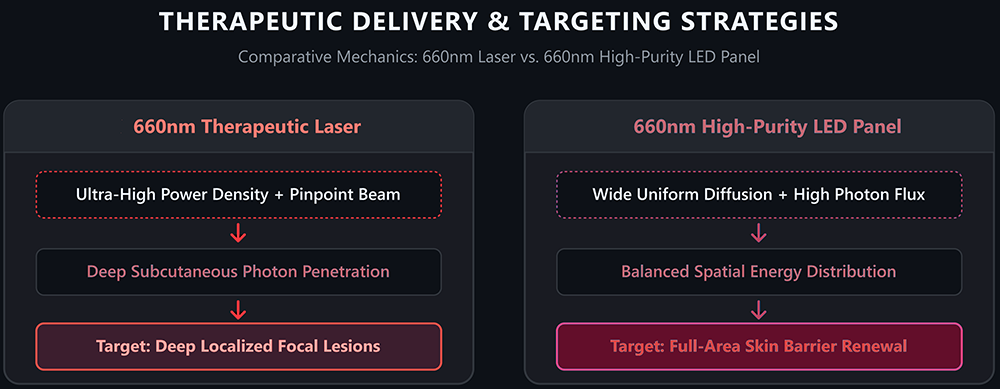
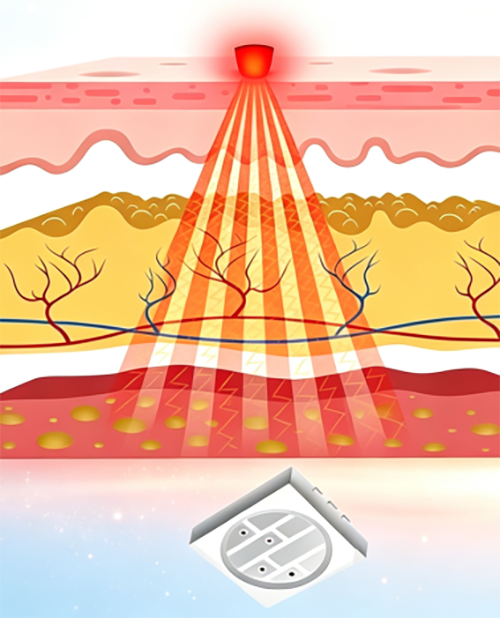
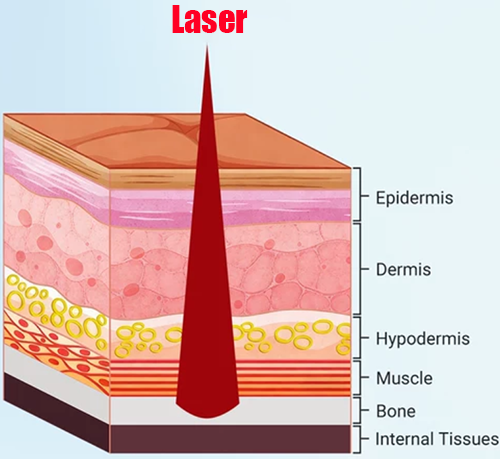
In photobiology, total penetration depth is primarily dictated by wavelength physics (absorption and scattering coefficients of tissue). However, lasers maintain higher localized power densities (mW/cm2) at deeper subcutaneous depths due to collimation, making them ideal for pinpoint lesions. Conversely, high-powered LED panels excel at delivering balanced photon volumes over expansive broad areas with even heat distribution rather than damaging focal hotspots.
Safety Profile and Operational Entry Threshold
| Feature / Dimension | 660nm Therapeutic Laser | 660nm High-Purity LED Panel |
| Regulatory Status | Class 3B / Class 4 Medical Device Strict clinical device registration; requires licensed medical personnel to operate. | Class II Medical Device / FDA 510(k) Cleared Officially registered as a medical-grade phototherapy device for safe, proven therapeutic efficacy. |
| Optical Safety Class | High Risk (IEC Class 3B / 4) Extreme focal intensity poses eye retinal damage risks and pinpoint thermal burn hazards. | Ultra-Safe (IEC Optical Class 1) Diffused scattering eliminates focal skin burn risks and retinal hazards, ensuring complete safety for unsupervised sessions. |
| Eye Protection | Mandatory wavelength-specific laser safety goggles. | Minimal protection required (avoid prolonged direct stare at close range). |
| Operational Threshold | High (Requires Licensed Professionals) Demands precise spot calibration, strict exposure timing (seconds), and exact distance monitoring. | Zero Threshold (Plug-and-Play Use) One-click operation. Users simply sit or stand in front of the panel for a fixed 10–20 minute session. |
Application Scenario Mapping
> Clinical & Medical Uses for Therapeutic Lasers
- Operational Setting: Strictly confined to specialized medical clinics, dermatology departments, and licensed physical therapy/rehabilitation centers under professional medical supervision.
- Safety Protocol: Demands rigorous clinical safety protocols, restricted room access, and mandatory wavelength-specific laser protective goggles for both clinicians and patients to mitigate retinal injury and pinpoint tissue thermal burn hazards.
Primary Applications
- High-precision focal therapy for stubborn localized tissue damage, vascular lesions, and hypertrophic surgical scars[7].
- Pinpoint, targeted repair of deep inflammatory nodules and severe post-traumatic tissue remodelling[7].
- Controlled transdermal drug/formulation delivery through micro-targeted thermal pathways.
> Home & Commercial Wellness Uses for 660nm High-Purity LED Red Light Panels
- Operational Setting: Highly versatile—ideal for unsupervised, daily household use as well as commercial wellness environments, including commercial gyms, athletic recovery centers, MedSpas, beauty salons, and luxury wellness clubs.
- Safety Protocol: Ultra-safe operational profile requiring zero clinical licensing or complex spot calibration; users simply sit or stand in front of the array for a hands-free, relaxing 10–20 minute session[4].
Primary Applications
- Full-Body & Full-Face Rejuvenation: Fading broad-area dullness, soothing widespread mild redness/erythema, strengthening skin barrier resilience, and encouraging broad-spectrum anti-aging collagen synthesis[4].
- Commercial Post-Procedure Care: Rapid, large-area skin soothing after superficial aesthetic treatments (e.g., IPL, microneedling, or light chemical peels) in professional salon environments.
- Systemic Athletic & Wellness Recovery: Supporting microcirculation to accelerate full-body muscle soreness relief and joint stiffness recovery across fitness centers, sports clubs, and wellness spas[7].
The Evolution of LED Technology: Narrow Spectrum & High Power Density
Historically, the PBM industry drew a rigid boundary: Lasers were viewed as high-power and narrow-spectrum, while LEDs were seen as broad-spectrum and low-power.
Modern optoelectronic engineering has redefined this boundary. Advanced semiconductor chip selection and precision packaging now allow high-end therapeutic LED panels to bridge the gap:
- Spectrum Compression: Through strict wafer sorting and optical filtering, high-grade LED chips compress their full width at half maximum (FWHM) spectral bandwidth toward narrower limits (~± 5nm), eliminating wasteful non-therapeutic thermal frequencies.
- Irradiance Breakthroughs: High-efficiency LED arrays paired with secondary optical lenses can now deliver immense photon flux densities across large coverage zones, rivaling clinical energy transfer while maintaining IEC Optical Class 1 safety[3, 4].
Real-World Empirical Performance: Professional Test Results
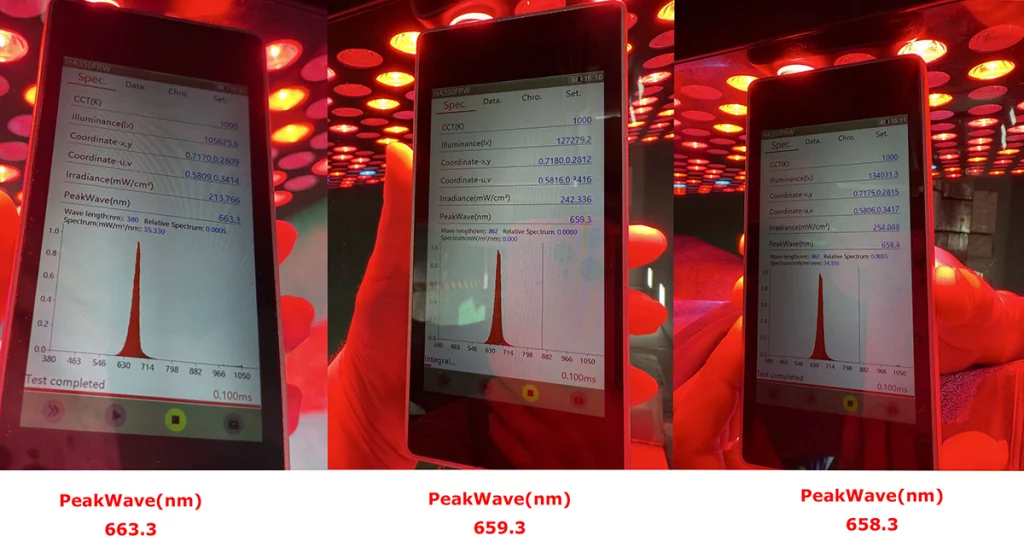
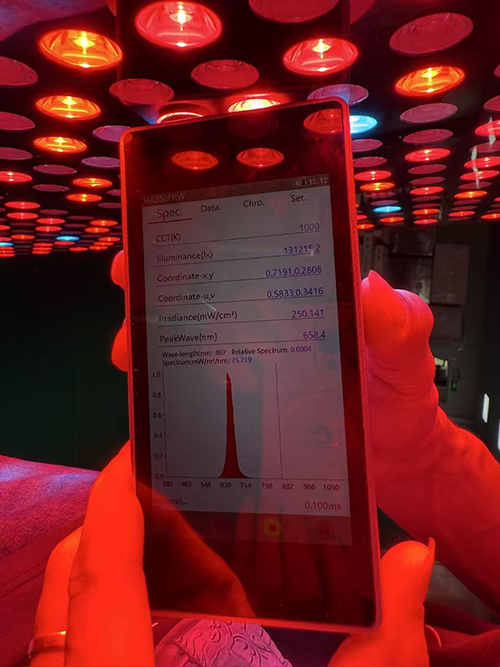
To demonstrate what a medical-grade LED panel achieves, consider our latest production model tested on a professional HA350-series optical spectrum analyzer.
Empirical Test Key Insights:
- True Narrow-Band Peak: The spectral curve demonstrates a clean, sharp peak centered precisely at 658.4nm – 663.4nm. Stray light leakage outside the 660nm biological absorption peak is virtually eliminated.
- Clinical-Grade Power Density: Delivering a measured irradiance of 210 to 250 mW/cm2, this panel provides high-density photon delivery across large skin surface areas—offering the deep energy throughput necessary for cellular activation while retaining complete home safety[6].
Comprehensive Comparison Table
| Core Parameter | Therapeutic Lasers (Medical Grade) | 660nm Professional High-Purity LED Panel |
| Single Photon Energy | 1.88 eV (at 660nm)[1] | 1.88 eV [1] |
| Light Generation | Stimulated emission, resonant optical cavity | Spontaneous electroluminescence, precision PN junction |
| Spectral Bandwidth | Ultra-narrow linewidth (FWHM < 5nm) | Highly compressed narrow spectrum (±5nm Binning, peak 658–663nm) |
| Coherence & Beam Style | High spatial/temporal coherence, collimated beam | Non-coherent; focusing optics (30°/60°/90° secondary lenses) for dense, uniform coverage [4] |
| Power Density (Measured) | High pinpoint focal intensity | Ultra-high broad irradiance (~250 mW/cm2 @ 0 inch) |
| Regulatory Status | Class 3B / Class 4 Medical Laser Device | Medical-Grade Registered (Class II FDA 510(k) Cleared) |
| Optical Safety Class | High Risk (Class 3B/4); mandatory specialized safety goggles | Optical Class 1 (Ultra-Safe); zero focal burn risks, safe for unsupervised daily use |
| Operational Setting | Specialized medical clinics & hospitals only | Home use, commercial gyms, MedSpas, salons & spas |
| Operational Entry | High (Requires licensed medical training) | Ultra-low (One-click plug-and-play operation) |
| Primary Target Area | Targeted clinical focal lesions & deep scar tissue | Full-face/body skin renewal, broad barrier repair, systemic recovery |
| Typical Application | Precision clinic spot repair & scar remodelling | Daily full-body rejuvenation, post-procedure care & athletic recovery |
References
- Planck, M. (1901). On the Law of Distribution of Energy in the Normal Spectrum. Annalen der Physik, 4(553), 1-11. (Fundamental Quantum Physics Baseline)
- Karu, T. I. (1999). Primary and secondary mechanisms of action of visible to near-IR radiation on cells. Journal of Photochemistry and Photobiology B: Biology, 49(1), 1-17. (Classic CCO Photoreceptor Pathway)
- Huang, Y. Y., Sharma, S. K., Carroll, J., & Hamblin, M. R. (2011). Biphasic dose response in low level light therapy. Dose-Response, 9(4), 602-618. (Classic Irradiance & Biphasic Dose Principle)
- Curyło, W., et al. (2025). LED photobiomodulation: From dermatological care to neuroprotection and pain management – review. Our Dermatology Online, 16(e595). (Comprehensive Review on Safety & High-Power LED vs Laser Mechanisms)
- Martín Pérez, C., et al. (2025). Efficacy of coherent (laser) vs non-coherent (LED) photobiomodulation therapy across systemic conditions: A systematic review and meta-analysis. Journal of Biophotonics, 18(2), e202400112. (Recent Meta-Analysis Confirming Equivalent Efficacy at Matching Irradiance)
- Rossato, L., et al. (2025). Photobiomodulation by 660 nm LED preserves cellular viability and mitochondrial homeostasis against H2O2-induced oxidative stress. Lasers in Medical Science, 40(1), 88-97. (Latest 2025/2026 In-Vitro Evidence on 660nm LED Mitochondrial Activation)
- Bonazza, F., et al. (2025). Photobiomodulation in chronic pain and tissue regeneration: A systematic review of randomized clinical trials. PMC / Frontiers in Neuroscience, 16, 12909510. (Latest Clinical RCT Systematic Review)